
Infant Classroom (Ages 6 weeks-1 year old)
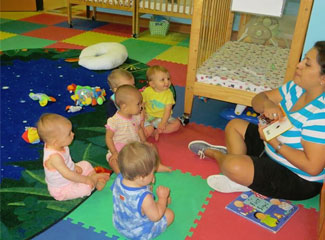 Congratulations on your new born child! I am sure your world is upside down at this point and you are wondering if it is ever going to get better. That is, if this is your first born, but if this is your second or third child you are already a pro at this. You know that what you are feeling right now, is a passing phase and that you and the world will be right very soon…just as soon as this little bundle of joy can talk, walk and look after him/herself!
Your child develops and grows quickly, the first few months it seems like all they do is sleep and eat. Then they are smiling, cooing and trying to get some movement into their body by pushing down and moving their arms around.
Our teachers are well aware of the developmental stages and the needs of babies. We provide the loving cuddling environment infants need, while at the same time ensuring they receive the necessary stimulation for continual growth and development.
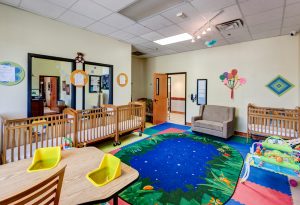 Your babies will have opportunities for tummy time (to help their upper body muscles get strong) and lots of space for crawling, climbing, rolling and practicing those famous first steps. We begin exposing infants to two languages, English and Spanish, and continue this through our Beginner class as well. By the time your child moves to the Beginner class they will be ready for the new and wonderful experiences and interaction they will find with other children.
What to Expect
- This is a class of great strides, your child will learn to sit, crawl, pull up to a standing position, walk with support of a teacher’s hand or furniture and; hopefully, be walking on his own before moving up to the Beginner class.
- They will learn to use their fingers by picking up items; putting the items in a container and taking them back out again. They will even attempt scribbling with a crayon.
- They will learn to explore objects by shaking, banging, throwing and dropping. (Just hide something and let them go find it!). They will imitate gestures, so be very careful, what you do is mirrored quickly by them!
- Your child will begin to respond to verbal requests, such as react to “no”, make simple gestures like shaking their head for no and will begin to babble with inflection.
- Your child may babble “dada” and “mama” and use exclamations such as “oh-oh”
- Socially and emotionally they develop in leaps and bounds. They enjoy imitating people in play, show preferences for certain people and toys and learn to finger feed themselves by 10-12 months.
What to Bring
- Diapers
- Wipes
- Diaper cream
- Pacifiers
- Two changes of clothing (season appropriate) in a 2 gallon Ziploc bag labeled with your child’s name.
- Monthly schedule with any change in diet or sleeping schedule.
What Not to Bring
- Toys or stuffed animals. Whatever your child needs we will be able to provide for them at school. The children are not allowed to have anything in their cribs with them.
- Please do not bring pacifiers attached to toys, we cannot use them at school.
Beginner Classroom (Ages 1-2 years old)
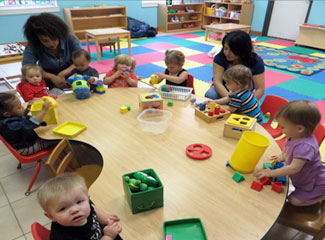 This is an exciting time or your child. He/she has just found out that they are mobile and don’t need any one to take them from point A to point B. This is the time to explore and find out about the world. Their little hands are busy exploring and learning. Learning that takes place through exploring and discovering is what a child keeps with him all through his life. This is a fun and exciting time for you and your child- enjoy the fun!
Dr. Maria Montessori emphasized that the hand is the chief teacher of the child. A child learns by fixing his attention on some task he is performing with his hands. All the equipment in a Montessori classroom allows the child to reinforce his casual impressions by inviting him to use his hands for learning.
- Here your child is going to be exposed to books, songs and activities. These are going to expose him to language and help grow his vocabulary.
- Social and emotional growth through activities which help him develop self-help skills and he begins to socialize by engaging in parallel play.
- Creative expression comes through singing song and moving to the music. He will be exposed to painting and drawing which will help develop his fine motor skills.
- He will also begin to recognize shapes, colors and numbers through activities, games and puzzles.
- You will see him make great strides in balance, co-ordination and fine motor skills.
 What to Expect
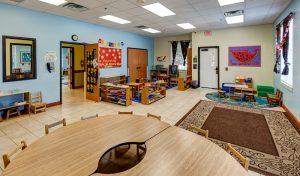
- Children of this age discover the joy of climbing, running, throwing and other motor skills.
- They also learn to co-exist with each other and establish boundaries (“ NO, MINE” is the favorite saying for this room).
- Your child has a good chance of falling, biting or being bitten. This is due to the fact that vocabulary is still sparse and developing.
- Children in this classroom will be weaned from bottles. They will drink from Sippy cups and progress to cups by the end of the year. Bottles are not encouraged.
- Daily feed back regarding their food intake, their nap time and diaper changes.
- Separation anxiety; as this might be the first time away from home.
What to Bring
- Diapers
- Wipes
- Diaper cream
- Pacifiers if needed (only nap time)
- Two changes of clothing (season appropriate) in a 2 gallon Ziploc bag labeled with your child’s name
- Lunch box with ice pack for keeping milk/food cold if your child is bringing his own food.
What Not to Bring
- Toys or stuffed animals. I know sometimes it is easier to drop off your child with a favorite toy. But this can cause some issues in the class. If another child has the same toy or doll at home, they may mistake it for theirs and what follows thereafter is not pleasant. The school cannot take responsibility for these toys being broken or misplaced. Furthermore, your child’s toy or doll is going to be a carrier of germs to and from the school. So, in the interest of everyone’s health and emotional well being we suggest that we encourage our children to keep our belongings at home.
Transition Classroom (Ages 2-3 years old)
“Learning Through Exploring”
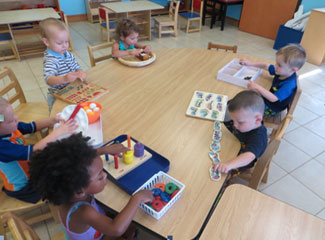 The Transition room and its curriculum is designed to help your 2 or 3 year old become independent and gain control and coordination of his movements. It expands upon what they had been learning and practicing in the Beginners class. Here we introduce a bit more structure and routine to their daily schedules. Cause and effect, being responsible for their actions, learning to reason… these are a few of the foundations being laid, on which the child works until maturity…sometimes through maturity!
- Here we begin the introduction to Montessori works. Simple works like rolling our rugs, scooping, pouring, sorting are all laying our foundation to language, prewriting and math.
- Beginning language skills are enhanced and your child’s vocabulary begins to grow rapidly helping him to be a fully functional member in his own society.
- Simple math and beginning letter recognition and phonics are the academic focus which helps the growth and development of the child’s intellect and concentration.
- While all this learning is going on your child also has a creative outlet through art, music and dance and gardening.
- The main focus is to never let a child risk failure, until he has a reasonable chance of success. We realize each child learns at his own pace.
 What to Expect
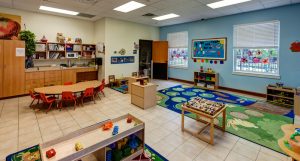
- Children will begin learning lessons in areas of practical life, sensorial, language, and math. Montessori introduction begins.
- Children in this class will drink out of regular cups during class time. Please leave sippy cups at home.
- Children will continue to learn about co-existing with each other and establishing boundaries ( “NO, MINE” is the favorite saying for this room)
- Children will hit and occasionally bite each other.
- Please understand that at this very active age, your child may fall or trip causing a bump or bruise. We will notify you immediately of any injury and will send home and “owie” report notifying you of details.
- Feel free to ask any questions to the teacher or director.
- Your child will be provided with a nap mat and a blanket from school.
- We strongly encourage children to do without their pacifiers during school time. If your child still uses a pacifier, it will be put away in their back pack during their stay with us. Hygiene is an issue with the use of pacifiers and also the development of language. We are encouraging the children to use words and are helping them form new words each day. A pacifier gets in the way of forming sounds needed for word/sound development.
What to Bring
- Velcro side Pullups
- Wipes
- Two changes of clothing (season appropriate) in a 2 gallon Ziploc bag. Label clothing with your child’s name.
- Backpacks to carry things to and back from school.
What Not to Bring
- Toys or stuffed animals. I know sometimes it is easier to drop off your child with a favorite toy. But this can cause some issues in the class. If another child has the same toy or doll at home, they may mistake it for theirs and what follows thereafter is not pleasant. The school cannot take responsibility for these toys being broken or misplaced. Furthermore, your child’s toy or doll is going to be a carrier of germs to and from the school. So, in the interest of everyone’s health and emotional well being we suggest that we encourage our children to keep our belongings at home.
Primary Classroom (Ages 3-6 years old)
“Follow the Child”
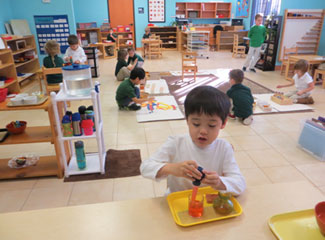 In a typical Montessori class subjects are interwoven; art, math, biology, language, botany are not isolated from each other and a child studies them in any order he chooses, moving through all in a unique way for each child. At any one time in the day all subjects are being studied, at all levels.
Adults and children both respect concentration and do not interrupt someone who is busy at a task. There are no grades, reward or punishments. The real test of whether or not the system is working lies in the accomplishment and behavior of the children, their happiness, maturity, kindness, and love of learning, concentration, and work.
Children are given the opportunity to take care of themselves, each other and the environment- gardening, cooking, building, moving gracefully, speaking politely, doing social work in the community, all make up for a well rounded, well adjusted and happy child.
Language
Language is a part of the culture of the race. The young child like his primitive ancestors is born with the potential to speak but can only make noises. Language is therefore acquired through learning. In a Montessori class the child learns the phonetic sounds of the letters before he learns the names of the letters. The thought behind it is that these are the sounds a child hears in a word. Reading is nothing but blending of sounds. Once he has mastered most of the sounds he will start blending and reading…then there is no stopping him. He is going to be reading all signs, posts and books.
Math
A child learns the basic concept of mathematics in either two ways. Concrete materials are designed to represent all types of quantities to allow a child to touch or move the items as he learns. In the Montessori environment, a child not only sees the symbol for 1, 10, 100, 1000, but he can also hold the quantities in his hand. Later, by combining this equipment, separating it, sharing it, counting it and comparing it, he can demonstrate to himself the basic operations of arithmetic. This activity gives him the satisfaction of learning by discovery rather than by being told. Eventually, he develops an early enthusiasm for the world of numbers.
 Practical Life Overview
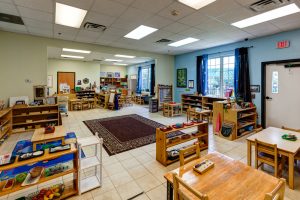
“Exercises in Practical Life” allow children to lead a practical life and do ordinary housework with a devotion. The objects that are used for practical life have no scientific purpose. They are the objects used where a child lives and which he sees employed in his own home, but they are especially made to his size. Although, the Practical Life Exercises may seem simple and common place, they are actually a very important part of the Montessori Program. These exercises make the child more independent and a useful member of his community, e.g. cleaning up after his/her snack, putting on their jackets, wiping the spills, etc.
Sensorial Overview
Sensorial training is of great importance in learning the basics of arithmetic. The conception of identity and difference in the sensorial exercises is built up from the recognition of identical objects and graduation of similar objects. He learns by repetition and gradually builds up a strong basis for more advanced arithmetic. Materials for the training of senses comprise a series of objects which are grouped together according to some definite quality which they possess, such as dimension, color, texture, sound, weight, temperature, taste, smell, form and position. The order of presentation is different for each child, depending on the age, experience and sensitive periods of child.
Cultural-Zoology-Geography Overview
Cultural Studies, Geography, and Zoology are combined in one area of the class room. Cultural Studies covers many areas of the world and different customs in the Montessori Classroom. We have children from many cultural backgrounds. We want the children to learn a little about them all. Geography is the study of maps, globes and land forms. Zoology is studies of animal life, parts of animals, life cycle stages and nature in general. We also learn about humans and families and our environment. Children will learn about the world and everything in it.
Extra Curricular Activities
- Spanish
- Music
- Ballet, Tumbling and Soccer are offered through special registration
What to Expect
- Class begins at 8:30am. We expect all students to be in the classroom and ready to start the day together.
- Children become more independent learning how to care for themselves and their environment.
- Children work quietly and independently as well as in group settings.
- Grace and manners are a focus of the classroom.
- Children will work on phonics and pre-reading skills daily.
- Exercises in math skills such as counting, matching and arranging will be completed daily.
- “Show n Tell” is an important way of sharing with the class. The children learn to talk in front of their friends, if they so please. They are encouraged to describe a favorite book, or a vacation or something that is special to them. Each class will announce their own day for “Show n Tell”. It is very important that we keep within the confines of the topic of that week.
What Not to Bring
- Please keep toys, nap pads, blankets, pillows and stuffed animals at home. WFMA will provide a nap mat and blanket for each child.
